The Three-Second Clip That Bothered Me
A few weeks ago I kept seeing clips of Dario Amodei on social media. The CEO of Anthropic. The guy who co-founded a company now valued higher than OpenAI.
One line kept replaying in my head: AI will replace software engineers.
As someone who codes for a living, I took it personally.
It is easy to dismiss a claim like that. It is also easy to let a three-second clip define how you feel about someone. Social media rewards that. But something about Dario's framing felt different from the usual AI hype. He did not sound like a founder selling a product. He sounded like someone who had thought through the implications and was being honest about what he saw.
So seven days ago I sat down and watched his full interview.
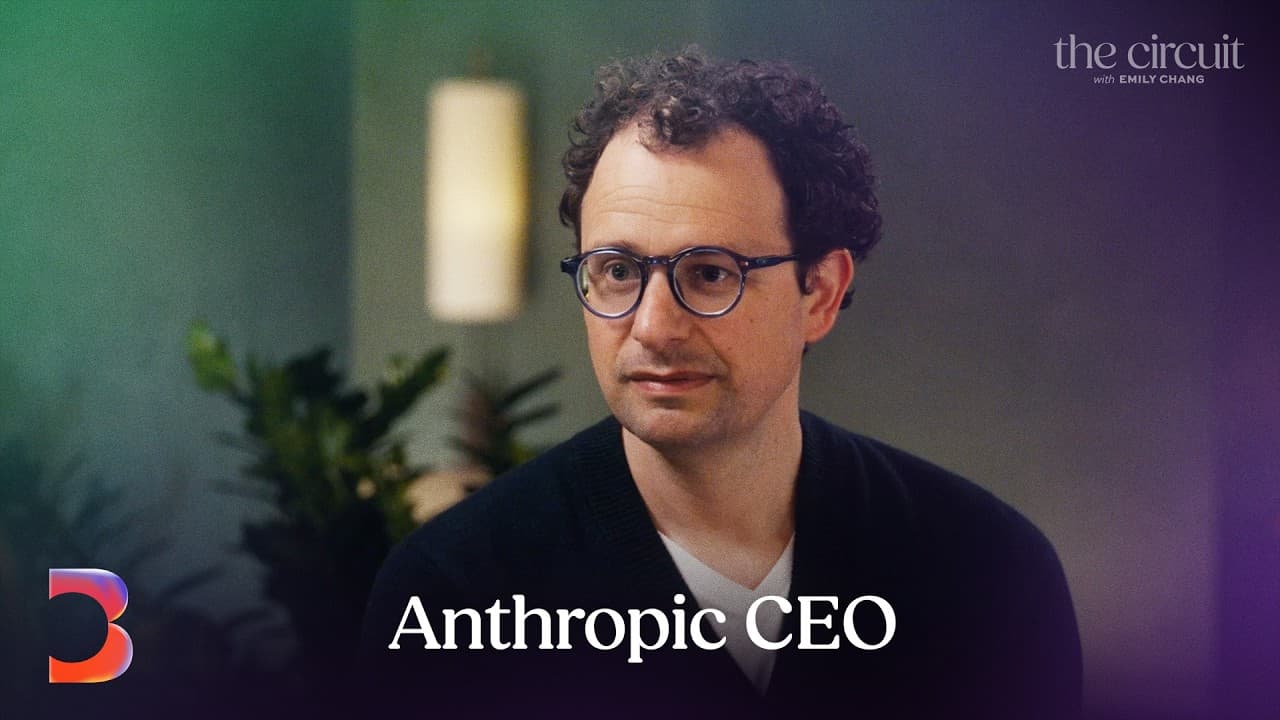
Inside the Mind of Anthropic CEO Dario Amodei | The Circuit | Extended Interview
Not clips. Not hot takes. Not the thing someone edited to make him look like a villain or a prophet.
The whole thing.
What I found surprised me. Not just about AI and coding, but about what kind of person ends up winning in a race this consequential.
Grace Hopper and the Fear That Never Goes Away
Before compilers existed, programmers wrote machine code by hand. Every instruction was a binary pattern. Every program was a direct conversation with hardware.
Then Grace Hopper built the first compiler.
People panicked.
They genuinely believed the machine would replace the programmer. If the computer could translate human-readable instructions into machine code, what was left for the human to do?
What actually happened is now obvious in hindsight: the compiler freed programmers to think at a higher level. Implementation became automated. Thinking became the job. The software industry did not shrink. It exploded. More people could build more things because the floor of what you needed to know got raised.
I think we are at the exact same inflection point with AI.
The Paradox That Changed How I See My Job
Here is the part of Dario's interview that stuck with me most.
The interviewer asked him whether he uses Claude to help write. His answer:
I have not gotten to the point where I actually allow text directly written by Claude... I basically use Claude to help me brainstorm, to help me think through the themes, to help me organize my own thoughts.
He then explained why:
Writing helps you struggle through ideas. There is a lot of critical thinking involved in that. Do we lose that if we let Claude do it for us? I'm a little worried about that. In fact, that's half the reason I write myself.
Let that sink in.
The CEO of one of the most advanced AI companies in the world does not let AI write for him. He uses it to brainstorm, research, and organize. But the final words are his.
Now contrast that with what he says about code:
AI writes all the code or almost all the code.
He pushes for AI to write 100% of code while personally refusing to let it write his essays.
This is not a contradiction. It is the most important distinction a developer can make right now.
Writing is thinking. Code is implementation.
When Dario writes an essay, the thinking and the words are one and the same. He cannot outsource the words without outsourcing the thought. The act of structuring a sentence, choosing a phrase, building an argument that is the thinking itself.
But code is different. Code is the output of thinking, not the thinking itself. The thinking happens before the code: What should this system do? Why should it work this way? What are the tradeoffs? How will it fail? Who is it for?
Once those questions are answered, the implementation is translation. And translation is exactly what compilers, interpreters, and now AI code generation are good at.
This reframes the entire AI-and-developers conversation:
Human work is not disappearing. It is moving upward.
We used to spend our best hours on syntax, boilerplate, debugging typos, and fighting framework configurations. AI handles that now. What it cannot do what it may never be able to do is decide what is worth building, why one architecture is better than another, whether a system is safe, or whether a tradeoff is acceptable.
That is the new floor of the developer's job.
Why Experienced Developers Push Back
I have noticed something in how senior engineers, architects, and builders talk about AI. There is a tendency to emphasize its failures. To point out the hallucinations. To say it produces low-quality code.
Some of that is genuine quality control. If you have built systems that handle millions of requests, you know what "good enough" looks like, and AI output often is not there yet.
But I think there is also something deeper.
If your identity as a developer is tied to writing good code to the craft of it, the precision, the elegance then a machine that writes passable code in seconds is a threat. Not to your job yet. To your story about yourself.
It is uncomfortable to admit that a significant portion of what you do every day is now automatable.
But reframing helps. If code is just implementation, and implementation is increasingly handled by AI, then your value is not diminished. It has shifted to something AI cannot touch: your judgment, your taste, your understanding of users, your ability to see how systems fail, your instinct for what matters.
That is not a demotion. It is a promotion.
The 100% Claim and the Slop Problem
Here is where I part ways with Dario.
His vision of AI writing 100% of code sounds clean in theory. In practice, open source is already showing us the cracks and they are not subtle.
Right now, maintainers of popular projects are drowning in AI-generated contributions. Plausible-looking PRs that do not actually work. Issues describing problems the submitter never experienced. Code that looks syntactically correct but ignores the entire architecture of the project.
This is not a hypothetical future problem. It is happening now.
Mitchell Hashimoto the creator of Terraform, Vagrant, and now Ghostty recently released vouch, an explicit trust management system for open source projects. Contributors must be vouched for before they can interact with certain parts of a project. Unvouched users get their issues and PRs auto-closed.
His reasoning:
The effort required to understand a codebase, implement a change, and submit that change for review was high enough that it naturally filtered out many low quality contributions... Unfortunately, the landscape has changed particularly with the advent of AI tools that allow people to trivially create plausible-looking but extremely low-quality contributions with little to no true understanding.
I also watched Mario Zechner talk about his agent harness project, pi.dev. Same problem. Same solution. Issues and PRs from unverified contributors are auto-closed. You need to demonstrate you are a real human who has actually engaged with the project before you can contribute. A contributor trust system built specifically because AI-generated slop made the old open source model unworkable.
These are not theoretical concerns from people who fear technology. Mitchell Hashimoto has been building developer tools for over two decades. Mario Zechner is literally building AI agent infrastructure. They believe in AI. They are also the first people telling you to gate the flood.
AI is the next compiler. But compilers do not spam your repo at 3 AM.
This is why I cannot get on board with the 100% claim. Not because of romanticism about coding. Not because I want to gatekeep the profession. But because code that compiles is not the same as code that belongs. Code that passes tests is not the same as code that respects the architecture, the conventions, the decades of accumulated taste that separate a maintained codebase from a dumpster fire.
I believe AI will handle more and more implementation. I believe human work will shift upward toward thinking, design, and judgment. But I do not believe in fully removing the human from the loop.
Not yet. Not at scale. Not when the slop is already this bad and the tools are still getting better at generating plausible-looking nonsense.
What Dario's Leadership Says About the AI Race
I went into the interview curious about his technical views. I came out equally struck by his character.
Watch Dario answer questions and you will notice something rare in tech leadership. He does not dodge. He does not reframe every answer into a product pitch. He does not pretend to have certainty where none exists.
When asked about OpenAI and Sam Altman, he could have said nothing. Instead he was direct:
When you feel that you can't trust someone, when you feel that their values are not what they say they are, when you feel that they're not honest... that makes it very hard to continue to work with a company.
He did not leave OpenAI over a technical disagreement about safety. He left over trust and values. He was willing to walk away from the most important AI company at the time because the people running it did not match what they claimed to be.
That takes conviction. It also takes a willingness to lose.
For most of Anthropic's history, they were the underdog. OpenAI had the brand, the consumer apps, the media presence. Anthropic focused on enterprise, on safety, on building models that were reliable before they were flashy. People called them "safety nerds." They called Dario an "ideological lunatic."
Then something shifted. Anthropic's valuation surpassed OpenAI's. As of recent reports, Anthropic sits at around $965 billion against OpenAI's $852 billion.
Now Dario could have framed this as beating his rival. He didn't:
The value of being the preeminent company... it's not about beating rivals for the sake of beating rivals. It's about having the ability to pull the ecosystem along with us.
That is a values-driven answer from someone who just won.
It made me think about something deeper. Dario picked a business model aligned with his principles enterprise over consumer, because consumer AI incentivizes engagement and addiction while enterprise rewards trust and long-term relationships. He publicly advocates for export controls on chips to China, even though his own chip partners disagree. He took a stand with the Pentagon: work with us on defense, but no mass surveillance and no fully autonomous weapons.
None of that is neutral. All of it is principled.
And in a field as powerful as AI, where the technology can cure disease or be weaponized, maybe the differentiator between the winners and everyone else will not be compute or model architecture. Maybe it will be clarity of values.
What This Means for Me
Back then I was defensive. AI was coming for my job, and the guy leading the charge seemed almost casual about it.
Today I see it differently but not as a full convert.
I agree with Dario that AI is the next compiler. That human work is moving from implementation to thinking. That the developers who thrive will be the ones who decide what and why, not just how.
But I cannot sign on to AI writing 100% of code. Not when open source maintainers are building trust gates just to survive the flood of AI-generated contributions. Not when the tools are getting better at generating plausible nonsense faster than projects can filter it.
Maybe the real job shift is not just upward from coder to architect. Maybe it is also outward from code generator to code steward. Someone has to decide what belongs in the repo. Someone has to keep the slop out.
And if Dario Amodei is any signal on the other side of this, the people who win in this new world will not be the ones who build fastest or accept AI most eagerly. They will be the ones who know what they believe and build accordingly.
That is the bigger picture I was missing.